
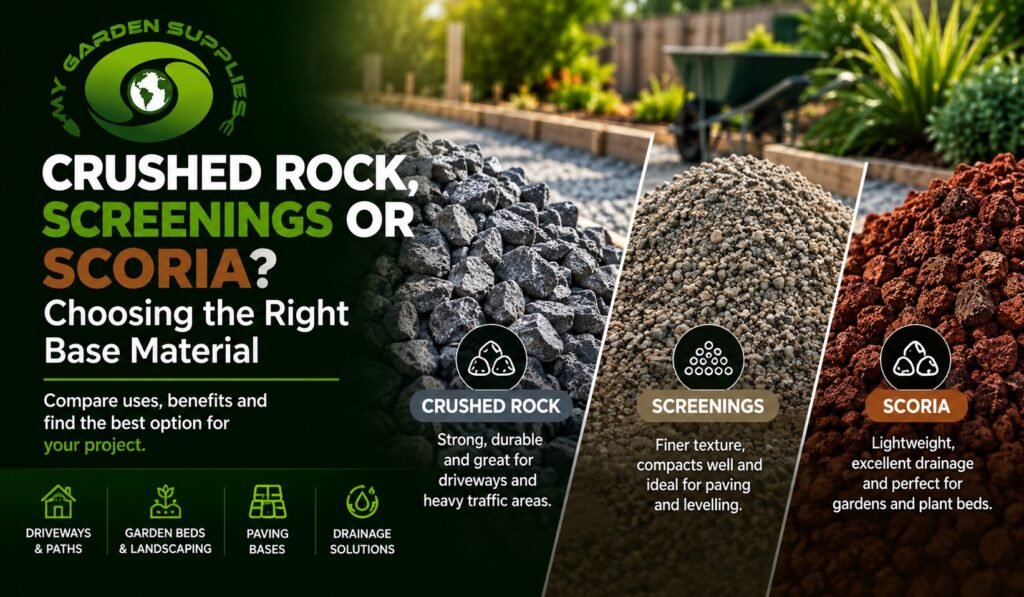
Most people walk into a landscaping yard asking which gravel they need. It is the wrong question, and it is why so many driveways develop potholes and so many paved areas ripple after a wet winter.
The right question is which layer you are buying for. A driveway, a path or a shed slab is not one material; it is a stack of them, and each layer has a completely different job. Get the order right, and the surface lasts decades. Put the wrong product in the wrong layer, and it will fail no matter how much of it you use.
The stack, from the bottom up
Subgrade. Your existing ground, once you have stripped topsoil and anything soft. Nothing you buy goes here.
Sub-base. Coarse bulk fill for depth and drainage, used when you have a deep excavation or soft ground to bridge.
Base. The structural layer. This is what carries the load, and it has to compact into a solid mass.
Bedding. A thin levelling course under pavers, covered in our sand guide.
Surface. What you actually see and walk on.
Every product below belongs to exactly one of those layers.
Crushed rock, the only one that truly binds
Crushed rock is graded from around 20mm all the way down to dust. That range is the entire point. The fine material fills the gaps between the larger pieces, and when you compact it, the whole lot locks together into something close to a solid slab.
This is your base layer for anything carrying weight. Driveways, shed slabs, paths, and the layer beneath paver bedding all want compacted crushed rock. Nothing else on this list will do this job, because nothing else has the fines to bind.
Screenings, which are for drainage and not for bases
Screenings at 20mm are the common size, with 14mm and 7mm also available, and they are used for general drainage work and on driveway surfaces. Screenings are single-sized and washed, with the fines taken out.
Because there are no fines, the stones cannot lock together. Drive on a layer of loose screenings, and they simply move aside, which is why a driveway surfaced with screenings develops ruts and wheel tracks unless there is a compacted base underneath doing the structural work.
What they are excellent at is letting water through. Backfill behind a retaining wall, surround for an agricultural drain, soakwells, and drainage trenches all want screenings precisely because water passes straight through rather than being held.
The single most expensive mistake in this whole category is ordering screenings as a driveway base. They look like road base to an untrained eye, and they behave like nothing of the sort.
Scoria, the lightweight option
Scoria is volcanic rock, full of tiny air pockets, which makes it dramatically lighter than granite or basalt for the same volume. It comes in a 5mm minus grade as well as 7mm and 20mm.
That low weight is useful in specific places: planter boxes and roof gardens where load matters, drainage layers where you do not want extra mass, and areas where barrowing heavy rock a long way is impractical. It also holds moisture in its pores, which is why it appears in garden bed and potting applications. The distinctive red tone makes it a decorative choice as well.
What scoria is not is a structural base. It crushes underfoot and under wheels over time, so keep it out of load-bearing layers.
Rubble and stone dust, the top and bottom of the stack
Rubble at 60mm is coarse recycled material for deep fill. If you have excavated 300mm or hit a soft wet patch, rubble bulks out the depth economically before the crushed rock base goes on top.
Stone dust, sometimes called crusher dust, is the 5mm minus end of the range. It screeds smooth and compacts hard, which makes it useful as a fine surface on garden paths or a levelling course. Bear in mind it holds water and can go greasy underfoot in a wet Melbourne winter, so it suits low traffic paths better than driveways.
How deep, and how to compact
Rough working depths for the compacted base layer:
- Garden path or walkway: 75mm to 100mm
- Residential driveway: 100mm to 150mm
- Shed slab or heavy vehicle access: 150mm or more, and worth getting engineering advice
Compaction technique matters as much as depth. Spread and compact in layers no thicker than around 100mm, because a plate compactor cannot densify a deep lift no matter how long you run it over the top. Dampen the material lightly as you go, since slightly moist crushed rock compacts far better than bone-dry material. Expect to lose roughly a fifth of your ordered volume to compaction, so build that into the quantity from the start. Our post on preparing a backyard for landscaping covers the excavation stage that comes first.
One local note. Melbourne’s northern suburbs sit on reactive clay that pumps up into a base layer when wet, contaminating it and destroying the compaction you worked for. A geotextile fabric between subgrade and base costs very little and prevents exactly that.
Finally, treat the plate compactor with respect. It transmits real vibration through the arms, so take breaks, and wet the surface down rather than letting dust lift, since crushed rock dust carries crystalline silica.
FAQs
Can I build a driveway out of screenings alone?
Not successfully. With no fine material to bind them, the stones shift under tyres and the surface ruts. Screenings can sit as a decorative or drainage top layer, but only over a compacted crushed rock base that is doing the structural work.
Is crushed rock the same as road base?
In everyday use, the terms overlap, and both describe graded material containing fines that compacts to a solid layer. Specifications and classes vary by application, so if you are working to a plan or a council requirement, tell us the class called for rather than the general name.
Do I really need geotextile fabric?
On clay, yes, it is worth it. Without a separation layer, the clay works its way up into the base over successive wet seasons, and the base loses strength. On free-draining sandy ground, it matters much less.
Can I use scoria under pavers?
Better not to. Scoria breaks down under sustained load, so the level you set today will not be the level in a few years. Save it for drainage layers, planters and decorative areas where nothing is bearing on it.
How do I know when the base is compacted enough?
The practical test is whether it stops moving. Once the plate compactor is no longer leaving visible depressions and the surface rings hard rather than sounding dull, the layer has done what it can. Walking across it should leave no footprint at all.
Build a Better Garden with Quality Supplies
Tell us what is going to travel across it. A path that takes foot traffic and a driveway that takes a loaded ute need different depths and, in places, different products entirely, and that single detail changes the order more than the square metres do. Describe the use and the ground conditions, and we will spec the layers, from fill through to surface.
Call (03) 9716 1333
Email enquiry@cemixvic.com.au
Yard at 2410 Plenty Rd, Whittlesea VIC 3757
Full range at mygardensupplies.com.au