
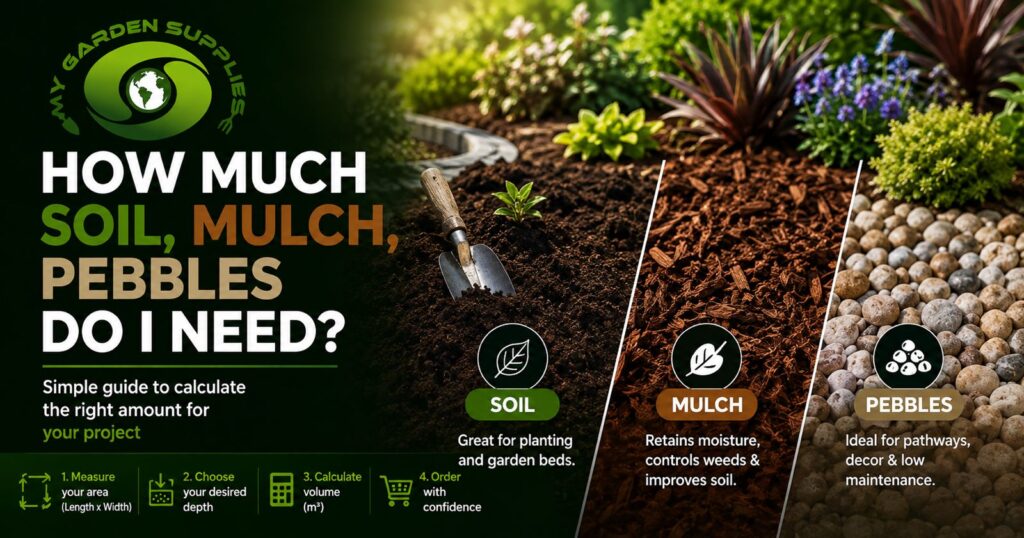
Ordering bulk landscaping material is one of those jobs where a small maths error turns into a very visible problem. Order short and the project stalls with a garden bed half covered and a second delivery to organise. Order long, and you have a mound of mulch sitting on the driveway that nobody in the household wants to shift.
The reassuring part is that every material sold by the cubic metre uses the same calculation. Learn it once, and it works for soil, mulch, pebbles, sand, toppings and crushed rock alike.
The only formula you need
Length in metres, multiplied by width in metres, multiplied by depth in metres, gives you cubic metres.
The one place people trip up is depth, because it is almost always quoted in millimetres while the other two measurements are in metres. Divide the millimetres by 1,000 to convert. So 50mm becomes 0.05, 75mm becomes 0.075, and 100mm becomes 0.1.
A worked example. You have a garden bed 6 metres long and 2.5 metres wide, and you want mulch at 75mm.
6 x 2.5 x 0.075 = 1.125 cubic metres.
Round that up to 1.2, and you are done. If you would rather not do the arithmetic yourself, the volume calculator handles the conversion and the rounding for you.
What a cubic metre actually covers
Coverage is not a fixed number, because it changes entirely with depth. One cubic metre spreads to roughly:
- 40 square metres at 25mm deep
- 20 square metres at 50mm
- 13 square metres at 75mm
- 10 square metres at 100mm
- 5 square metres at 150mm
Keep that list handy as a sense check. If your calculation says you need eight cubic metres of mulch for a small courtyard, something has gone wrong in the depth conversion.
How deep each material should go
Mulch. Between 50mm and 75mm suits most garden beds. Push toward 75mm where weed suppression is the main goal, because thinner layers let light through and weeds find it. Going much beyond 100mm can start working against you, since light rain struggles to penetrate and the lower layer can turn sour. Whatever depth you choose, pull the mulch back a hand’s width from trunks and stems. Fine grades such as sugar cane mulch settle noticeably more than chunky bark, so start them at the upper end of the range.
Garden soil. A brand new bed wants 200mm to 300mm of quality soil to give roots somewhere to go. Topping up an existing bed is usually 50mm to 100mm. Under new turf, allow 100mm of underlay. If you are not sure which blend suits your beds, our guide on choosing the right soil type for your garden walks through the differences.
Decorative pebbles. Aim for 30mm to 50mm across beds and pathways. A useful rule is roughly double the stone size, so 20mm pebbles want about 40mm of depth to stop the ground showing through. Oversized feature stones in the 60mm to 150mm range are placed by hand rather than spread to a depth, so those get counted, not calculated.
Toppings and crushed rock. Compacted paths generally want 75mm to 100mm. Driveways want 100mm to 150mm. Remember these materials lose height when they are rolled or plate compacted, so the finished depth is not the ordered depth.
Odd shapes, curves and slopes
Very few backyards are neat rectangles. Break an awkward area into two or three rectangles, calculate each one, then add the results together. For a circle, multiply the radius by itself and then by 3.14. For a curved bed, measure the width at its widest point and its narrowest, then use the average.
Slopes need a little extra thought, because material naturally creeps downhill and the low side ends up deeper than planned. On anything more than a gentle fall, add a bit of headroom to your figure.
Allow for settling and spillage
Your calculation gives you a theoretical volume. Real projects lose a little along the way, through spillage, uneven ground and the settling that happens after the first decent rain. Adding 5 to 10 per cent to soil and mulch orders covers it. For anything you intend to compact, such as toppings or crushed rock under paving, allow closer to 20 per cent, because compaction genuinely reduces the volume.
Weight is the limit, not volume
This catches people out more than anything else. A cubic metre is a fixed volume but a wildly variable weight. Mulches are light, often 300kg to 400kg per cubic metre. Soils and composts commonly run between one tonne and 1.4 tonnes. Sands, pebbles and crushed rock are heavier again, frequently 1.5 to 1.7 tonnes.
That matters if you were planning to collect it yourself. A standard six by four box trailer holds roughly half a cubic metre when loaded level, which sounds fine until you realise half a cubic metre of crushed rock weighs around 800kg and exceeds what many trailers are rated to carry. Mulch in the same trailer is a non-event. Rock is a different conversation, and delivery is usually the sensible answer.
Worth knowing for the spreading, too. One cubic metre is about 12 to 15 wheelbarrow loads. Three cubic metres of soil is a genuinely full weekend for one person.
Before the truck arrives
Check that a tipper can reach the drop point, that the gate is wide enough if the pile needs to go through it, and that nothing is parked where the load has to land. Put a tarp down on decorative driveways so the clean-up is quick. Have someone on site who can point at the exact spot, because moving a pile twice is the one job nobody enjoys.
FAQs
Is a cubic metre the same as a tonne?
No, and confusing the two is the most common ordering mistake. A cubic metre measures space, a tonne measures weight. A cubic metre of mulch might weigh 350kg while a cubic metre of pebbles weighs closer to 1.6 tonnes. Always confirm which unit a product is sold in before you compare quantities.
How many wheelbarrow loads are in a cubic metre?
Roughly 12 to 15, depending on barrow size and how bravely you fill it. Heavy materials like soil and rock are usually barrowed at part capacity, so expect the higher end of that range.
Can I order less than a full cubic metre?
Smaller quantities are generally available, and for very small jobs bagged product often works out easier to handle than a bulk drop. Give us the area and depth, and we will tell you honestly which format suits.
Do I need to remove the old mulch before topping up?
Usually not. Old mulch breaks down into the soil and does useful work while it does so. Rake it level, check the total depth once the new layer is on, and only remove the old material if it has matted into a water-repellent crust.
My site slopes. Should I order extra?
Yes, a little. Material migrates downhill and settles deeper at the low end, so the average depth ends up above what you planned for. On a noticeable slope, add around 10 per cent to your calculated figure.
Get Your Garden & Landscaping Supplies from My Garden Supplies
Do the measuring, then let us check the numbers before anything gets loaded. Send through the length, width and the depth you are aiming for, and we will confirm the cubic metres and flag whether your access suits a tipper delivery or a smaller drop.
Call (03) 9716 1333
Email enquiry@cemixvic.com.au
Visit the yard at 2410 Plenty Rd, Whittlesea VIC 3757
Browse the full range at mygardensupplies.com.au
Bulk delivery across Melbourne’s northern suburbs, seven days a week.