
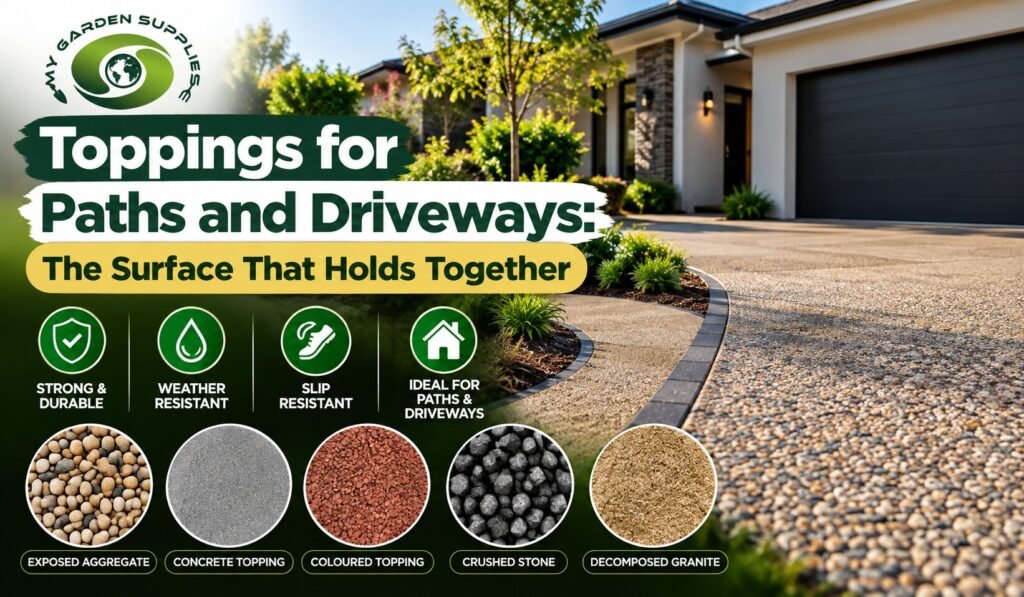
There is a gap in most people’s mental list of path surfaces. Concrete is permanent and expensive. Pavers take skill and a proper base. Loose pebbles look beautiful for a fortnight and then scatter into the lawn, roll underfoot and end up in the mower.
Toppings fill that gap, and they are the most underappreciated product in any landscaping yard. Walk through any established Melbourne garden with a path that looks like it has always been there, firm underfoot and softly coloured, and you are almost certainly standing on toppings.
What makes a topping different
A topping is graded material that runs from a small top size, commonly 7mm to 14mm, all the way down to dust. That full range is what separates it from everything else on the shelf.
The fines pack into the spaces between the larger particles. Add a little moisture, compact it, and the whole layer knits into a firm surface that still drains and still looks like stone rather than pavement. You get a path that holds its shape under foot traffic without being sealed, poured or laid.
This is the same binding principle as the crushed rock we use for structural bases, with one important difference. Crushed rock is chosen for strength and looks industrial grey. Toppings are chosen for colour and texture, because they are the surface you actually see.
The main toppings, and how they differ
Seymour. A whitish grey granitic material, available from 7mm through to 20mm. It compacts to a firm, pale surface that suits contemporary gardens and sits well against rendered or light coloured houses.
Batesford. Quarried limestone from near Geelong, in warm earthy tones. Limestone fines have a natural binding quality, which is why Batesford is a long standing favourite for rural driveways and long entrances where the surface has to stay put with minimal maintenance.
Tuscan. Warm terracotta and earth tones. The choice when you want the path to read as warm rather than cool, and it works particularly well with red brick and native planting.
Granitic sand. The finest option, a golden brown material used for paths, dry creek beds and garden bed surfaces where you want something walkable but soft-looking.
Colour is the deciding factor for most people, and it is worth seeing the options against your own house. Batesford and Seymour sit at opposite ends of the warm and cool range, so seeing them side by side usually settles the decision quickly.
Getting the depth right
For a garden path carrying foot traffic, 50mm to 75mm of compacted topping over firm ground is the working range. Spread it in two layers rather than one, dampen it lightly, and compact each layer. Dry material will not bind no matter how long you run a compactor over it.
That depth makes the quantity easy to picture. A cubic metre spread at 50mm covers around 20 square metres, so a path one metre wide and twenty metres long takes roughly a cubic metre before compaction. Measure the path at its widest point if the edges wander, because a curving path quietly uses more material than a straight one of the same length.
Driveways are a different job. A topping is a wearing surface, not a structural layer, so a driveway needs a properly compacted crushed rock base underneath before any topping goes on. Skipping that step is why gravel driveways develop potholes that keep coming back no matter how much new material gets raked over them.
Build in a slight fall across the path so water sheds sideways rather than running down its length, which is what scours channels into an otherwise good surface. Keep that fall running away from the house and away from any slab.
Edging is not optional
A compacted topping still has a loose edge, and without something to hold it, the path slowly spreads outward and thins in the middle. Steel, timber or concrete lawn edging keeps the material where you put it and gives the path a defined line, which matters as much visually as it does practically.
Edging also stops the path migrating into garden beds and lawn, which saves you from mixing topping through soil you will later want to plant into.
Living with a toppings path
Expect to top up thinly every few years in high traffic spots, particularly at gates and corners where feet turn and scuff. That is normal and inexpensive, and it is one of the reasons the surface ages well rather than cracking like concrete.
Weeds will eventually establish in any permeable surface. Keeping the layer at full depth is the most effective defence, since weed seed struggles in a well-compacted surface. For ideas on combining a path like this with planted areas, our post on designing a low-maintenance garden with pebbles and mulch covers how the surfaces work together.
Through a wet Melbourne winter a well-compacted topping drains and stays walkable, which is a real advantage over lawn or bare soil. One caution worth knowing: limestone fines can become slick when saturated, so on a steep run consider stepping the path rather than laying one continuous slope.
FAQs
What is the difference between toppings and crushed rock?
Both contain fines and both compact, but they are chosen for different reasons. Crushed rock is a structural base material selected for strength and is usually grey. Toppings are selected for colour and texture and are meant to be the visible surface. On a driveway you often need both, with the crushed rock underneath.
Will a toppings path turn muddy in winter?
Not if it is properly compacted and laid to full depth over firm ground. A well knitted surface sheds most water and stays walkable. Mud usually means the layer is too thin, was never compacted, or is sitting directly on soft clay with no drainage fall.
Can I lay toppings straight over grass?
It is a shortcut worth avoiding. The grass dies, decomposes and leaves a soft spongy layer under the path, which then settles unevenly. Strip the turf and compact the ground first, and the path will hold its shape for years.
Do toppings need to be sealed or stabilised?
Not for a garden path. The fines do the binding on their own once compacted. Stabilised products exist for high-traffic commercial applications, but for a residential path the natural material performs well and can be topped up easily, which a sealed surface cannot.
How much should I allow for compaction?
Order a bit more than the raw calculation suggests, because compacting the layer reduces its volume noticeably. The same applies to the natural settling that happens over the first few weeks of use.
Need Garden Supplies? We’ve Got You Covered
Colour is the part people regret getting wrong, and a path is a large area to live with. Send us a photo of the space along with the house behind it, and tell us whether the path is for foot traffic or vehicles. We will suggest which toppings suit the setting, how deep to lay it for that use, and what edging will keep it looking sharp.
Call (03) 9716 1333
Email enquiry@cemixvic.com.au
Yard at 2410 Plenty Rd, Whittlesea VIC 3757
Full range at mygardensupplies.com.au