
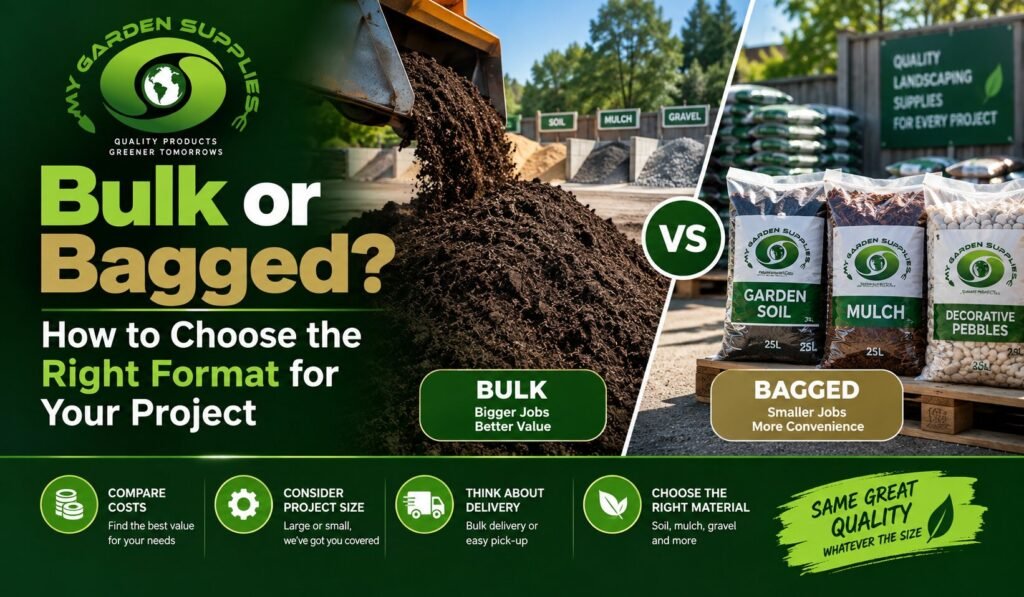
Once you know how much material a project needs, the next decision is how it should arrive. Most people assume the answer is purely about price per unit, and that bulk is always the smarter buy. It usually is for bigger jobs. But the right format depends just as much on where the material is going, how quickly you will use it, and whether a truck can physically get anywhere near the spot.
Three formats, not two
The choice is often framed as bulk versus bags, but there are really three options on the table.
Retail bags. Carry-sized bags you can lift into a car boot, stack in a garage and open one at a time. Ideal for small quantities and tight spaces.
Bulka bags. Large woven bags that hold a substantial load, commonly in the region of a tonne depending on the material. They sit between the other two formats, keeping material contained without the cost of dozens of small bags.
Loose bulk. Tipped straight off a truck onto your driveway or a tarp. The most economical way to move volume, and the least forgiving if you have nowhere to put it.
The yard carries all three, from a bagged products range for smaller jobs through to tip truck loads for full landscaping builds.
Where the crossover sits
The quickest way to judge it is to translate a cubic metre into bags. A cubic metre is 1,000 litres, so in 25 litre bags of soil or mulch, that is roughly 40 bags. For heavy materials sold by weight, the numbers climb fast. A cubic metre of sand weighs in the order of 1.5 tonnes, which works out to around 75 of the 20kg bags people typically carry.
Picture carrying 40 bags from a car to the backyard, splitting each one open, and disposing of 40 plastic bags afterwards. For most people, that is the moment the decision makes itself. As a working rule, once a single material heads past about a third of a cubic metre, loose bulk or a bulk bag will almost always be the easier and more economical path.
When bags are genuinely the better choice
Bags are not just for people who cannot be bothered with a delivery. They win outright in several situations.
- Small jobs and top-ups, such as refreshing a couple of pots or a single raised bed.
- Tight access. Many townhouses in the newer estates around Mickleham, Donnybrook and Wollert have no side access and a single garage between the street and the courtyard. Carrying bags through the house is often the only realistic option.
- Storage over time. A bag of potting mix or fertiliser kept in a shed for months. A loose pile on the nature strip does not.
- Several products in small amounts. If you need a little of four different things, bags avoid four part loads.
- Anything that must stay dry until the moment of use.
That last point is why cement is almost always bagged. Cement starts hydrating as soon as it meets moisture, so it is sold sealed and should stay sealed until mixing day. Our cement products page covers the bagged range, from general purpose and off-white cement through to mortar mix, hydrated lime, builders clay and rapid set concrete for fence posts.
When loose bulk wins
Bulk comes into its own when the volume is large, the material will be used within days, and there is a clear drop zone the truck can reach. New garden beds, full mulching jobs, paver bases and lawn preparation all fall naturally here. You also avoid the plastic waste entirely, which on a job of several cubic metres is a significant pile of rubbish.
The trade-off is that loose material starts to move the moment it lands. Wind lifts fine mulch, rain washes sand and soil into gutters, and every day it sits is another day of mess. In a Melbourne winter especially, have a tarp ready and a plan to barrow the pile away quickly.
Where bulka bags earn their place
A bulka bag keeps a large quantity contained, so it can sit on a driveway for a week without spreading across it. It suits staged projects where you are working through material over several weekends, sites where a loose pile would block a shared driveway, and owners who simply want less clean-up. If the truck has a crane or you can arrange a forklift, the bag can be placed more precisely than a tipped load.
Planning the delivery
Deliveries run as either a tip truck load or a retail bag delivery, so a single order can bring both. Check that we cover your suburb on the areas we serve page, then think about exactly where the material should land.
If the only option is the nature strip or the roadway, check with your council first. Many Melbourne councils regulate materials placed on council land, and a load left on the footpath can draw attention quickly.
For a broader look at how all of this fits into a project, the complete guide to landscaping supplies walks through the main material categories side by side.
One handling note. Bags of cement and sand are heavy and awkward, so lift them close to your body with your legs rather than your back, and wear gloves when working with cement, since it is strongly alkaline and can burn skin when wet.
FAQs
How many bags are in a cubic metre?
For soil, mulch or potting mix in 25 litre bags, around 40. For heavier materials sold in 20kg bags, such as sand, the figure is closer to 75, because a cubic metre of sand weighs roughly 1.5 tonnes. Always check the bag size, since litres and kilograms are not interchangeable.
Can bulk material be delivered to a townhouse with no driveway?
Sometimes, but it depends on where the truck can safely tip. If the only drop point is the street, a bulka bag is often a better fit than a loose load, since it keeps the material contained. For very tight sites, retail bags are usually the practical answer.
Is bagged soil different from bulk soil?
Often, yes. Bagged garden products are usually blended for a specific use, such as potting or raised beds, while bulk soils are designed for larger ground-level work. Match the product to the job rather than assuming they are the same material in different packaging.
How long does bagged cement keep?
Unopened and stored somewhere dry, it keeps for months. Once a bag is opened, humidity starts to affect it, so fold and seal it tightly or use it soon. If you notice hard lumps that do not crush between your fingers, the cement has started to set and should not be used for structural work.
Can I order bulk and bagged products together?
Yes. A combined order is common, such as a loose load of garden soil with a few bags of fertiliser and a bag of cement for a fence post. Grouping them into one delivery saves a second trip.
Shop Quality Garden Supplies for Every Project
Not sure which side of the line your job falls on? Send us the full shopping list, loose and bagged, along with a quick description of how the truck would reach your property. We will suggest the format for each item and put the whole lot on one delivery, so you are not juggling a bulk drop on Saturday and a car full of bags on Sunday.
Call (03) 9716 1333
Email enquiry@cemixvic.com.au
Yard at 2410 Plenty Rd, Whittlesea VIC 3757
Full range at mygardensupplies.com.au